





Dean DeBiase is a best-selling author and Forbes Contributor reporting on how global leaders and CEOs are rebooting everything from growth, innovation, and technology to talent, culture, competitiveness, and governance across industries and societies.

How The Next Great Brands Will Change Perception And Not Chase Attention

By Dean DeBiase
Celebrity-backed spirits brands have become a fixture of the alcohol industry. Over the last decade, actors, athletes, musicians, and influencers have launched products across nearly every category, drawn by the appeal of ownership, consumer affinity, and the ability to translate personal brands into scalable businesses. C-Suite leaders, who look to partner with or acquire celeb-brands, have struggled to identify the formula that separates wheat from the chaff, in this evolving wild-west sector. So, I took a look under the hood of a few companies, and discovered success themes emerging in this billion-dollar market.
While some brands have become category-defining successes with massive exits to the big dogs of booze, like George Clooney’s Casamigos, sold to Diageo for $1B (NYSE: DEO), others, from 901 Tequlia to Qream, have found it difficult to distinguish themselves in an increasingly saturated marketplace—and many have either faded or failed.
What C-Suites Can Learn From the Next Generation of Celebrity Brands
That’s why I was curious to talk with actor Eric Winter, co-founder of Palm Republic, who is betting on one category. Rum. Specifically betting on the future of premium rum—and he is all in. As celebrity-backed brands continue to proliferate across consumer categories, with mixed results, Palm Republic Rum offers CMOs and entrepreneurs a live case study in strategies that place category advocacy ahead of celebrity itself.
Going into the conversation, I expected the same old celebrity meets spirits story. But I was wrong. Instead, what I found was an enlightened and inspiring reboot conversation centered around category building. Winter spent surprisingly little time talking about fame, audience reach, or personal branding, as most other did. Instead, he focused on a question that I asked that sits at the heart of Palm Republic’s strategy: Why hasn’t rum experienced the same premium evolution as crowded categories like tequila, whiskey, or bourbon?
The answer, and the story behind it, was compelling.
Over the past two decades, tequila has transformed from a party staple into one of the spirits industry’s most dynamic premium categories. American whiskey has benefited from a growing culture of collectors and enthusiasts. I have experienced this first-hand as a few of my friends and colleagues have launched purposeful vodka and bourbon brands, like Dee Robinson’s Good Trouble.

Along the way, influencers have encouraged consumers, who have become increasingly interested in provenance, production methods, and craftsmanship, helping elevate entire categories in the process. Rum, however, occupies a different, often misunderstood, position.
Despite being one of the world’s oldest and most diverse spirits categories, it has often remained associated with cocktails, often too sweet, rather than a premium sipping offering. Rum and Coke drinkers, you know who you are. For many consumers, rum still carries perceptions that don’t fully reflect the complexity and quality found throughout the category. That is challenging for big brands to attack and monetize.
Challenge accepted. Winter founded this brand on the hope and belief that there’s an opportunity to reboot and reshape those perceptions, and in the process, carve out a differentiated position within the luxury spirits landscape.
Never Leave Serendipity To Chance
The story began nearly two decades ago during a trip to Puerto Rico with Winter’s now-wife—actress Roselyn Sanchez. There, his future father-in-law introduced him to a side of rum that extended far beyond the tropical drinks he and most consumers associate with the category. The experience sparked a lasting appreciation for the spirit and planted the seed for what would eventually become Palm Republic.
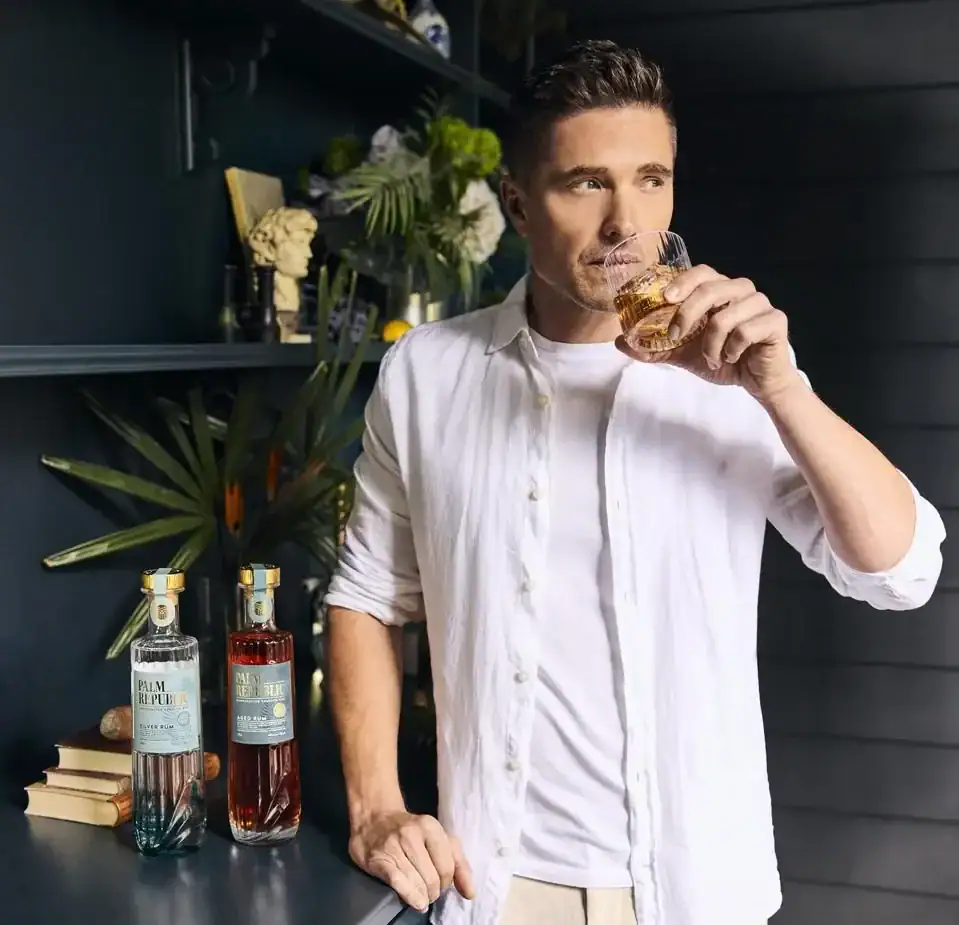
Years later, after a tremendous amount of research, he decided to transform that long-held passion into a business. And he took a bold approach. Winter commented, “I decided to raise capital and build an experienced team with a simple but ambitious goal, starting with two core products, and create a premium rum brand capable of showcasing the category’s depth while appealing to modern consumers seeking authenticity, transparency, and quality.” Serendipity? Perhaps, but in the world of packed consumer shelf space timing is everything, and maybe it’s just rums turn for the consumer spotlight.
“Rather than focusing on a single-country identity, we built a portfolio around a multi-origin blending approach, sourcing rum from countries including Jamaica, Panama, and the U.S. Virgin Islands”, Winter added. This strategy seems to reflect a belief that blending can create greater complexity and balance while allowing the distinctive characteristics of multiple rum-producing regions to complement one another in a single expression.
Wellness And Emerging Health Trends
When I asked about wellness impacting happy hour, Winter commented, “We felt it was equally important for the company to position itself around transparency, with products that contain no added sugars, flavors, or colorings, aligning with broader consumer demand for cleaner labels and a clearer understanding of what’s in the bottle”. The company has extended that philosophy into a portfolio and online platform of low-sugar cocktails made with minimal, natural ingredients.
Taken together, these decisions reveal a larger ambition that leaders can learn from. Rather than just trying to launch yet another spirits brand, many founders are betting that consumer perceptions, in this case for rum, are still evolving, and that there is room for a premium brand to help drive that conversation forward. This, like other consumer category trends, seems like a timely void to fill. But the stakes are high.
That type of ambition can lead to risky opportunity choices for brands.
My conversation comes as the company prepares for significant expansion into additional markets across the United States, a notable milestone for a brand that has spent its first two years focused on establishing its identity within a messy competitive category.
Growth, of course, is never guaranteed in the spirits, cannabis, or other related businesses—with irrelevance, obscurity, and decline lurking around the blind spots and industry peculiarities. For entrepreneurs, and even seasoned consumer brand CxO’s, the sector landscape of potholes can be daunting. Probation inspired distribution networks are frustrating, shelf space is hyper-competitive, consumer attention is fragmented, and new brands enter the market every year. Yet Palm Republic’s story highlights an increasingly important lesson for founders and CMOs operating in overcrowded categories across consumer brand sectors. Awareness can create an opportunity, but doesn’t guarantee durability. Sometimes you need a higher purpose to market.
Category Building Beats Celebrity: A New Consumer Brand Playbook
Products that endure are typically ones that offer consumers a clear reason to care beyond the founder or brand attached to the label. They solve a problem, challenge a perception, or create a new way of thinking about an existing category. For them, that meant building a brand that aspires to participate in the luxury spirits conversation, not simply as a premium rum, but as a premium spirit.
Yeah, I know, it took me a while to comprehend significance of this category shifter move. Whatever sector you’re in, the opportunity can be quite challenging, and for Winter, the reboot zone was found in not just launching a product, but elevating rum’s position within the premium spirits landscape.
The company seems to be making progress on that mission, with recognition in prominent industry competitions, lending credibility to its category-first booster approach. It recently launched a refined redesigned bottle and visual identity, underscoring its ambition to compete not only within premium rum, but within the broader luxury landscape.
The company’s early momentum suggests there is room in the market for brands that lead with product, craftsmanship, and a clear point of purpose. And in today’s increasingly complex consumer marketing chaos, that may prove to be a meaningful advantage. Before publishing, I made sure to verify and taste-tested their latest product. It does not disappoint.